
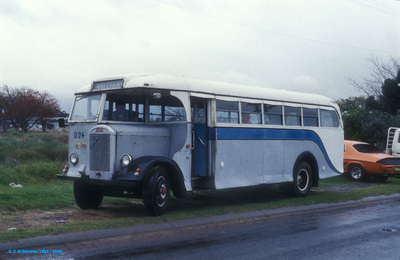
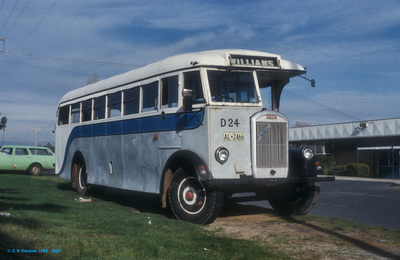
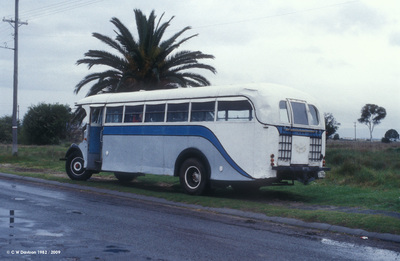
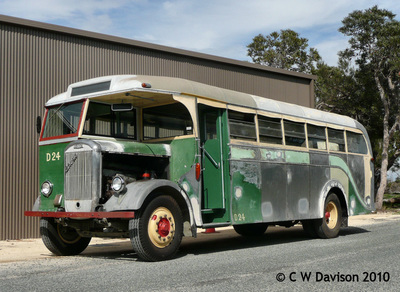
1947 Dennis Lancet J3 (WAGR Coach D24)
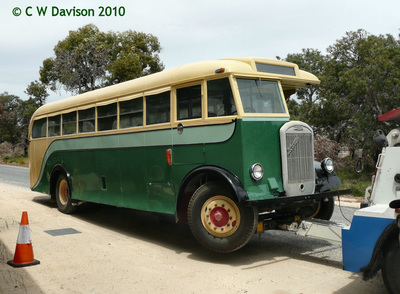
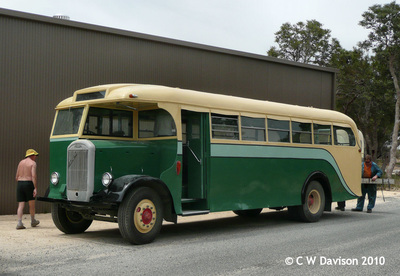
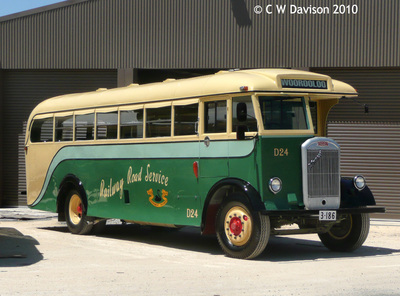
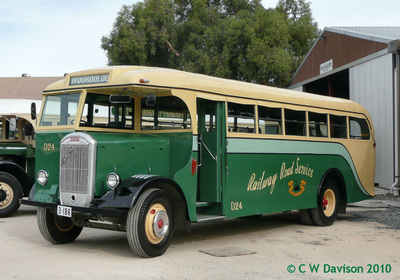
Dennis Lancet J3 — WAGR Coach D24
The vehicle
| Year | 1947 |
|---|---|
| Make / model | Dennis Lancet J3 |
| Fleet number(s) | WAGR Coach D24 |
| Manufacturer | Dennis Brothers, Guildford, Surrey, England |
| Model | J3 |
| Type | Half Cab |
| Engine | Dennis 06.76 six cylinder diesel 7.6 litre, 62 bhp |
| Transmission | Dennis four-speed crash with pre-select overdrive |
| Brakes | (not specified) |
| Suspension | (not specified) |
| Body: Manufacturer | Steel framed, believed to have been imported from the United Kingdom in kit form |
| Body: Seating | 34 seats |
| Status | Not recorded in the crawled source — confirm operational/restorable/spares status with BPSWA before publishing. |
The story
This vehicle, new to the Western Australian Government Railways (WAGR) in 1947, is the sole surviving WAGR half cab bus imported into Western Australia from the United Kingdom. Of the other half cabs imported at the same time, they were either converted to 'full front' configuration or scrapped. During its WAGR service, D24 was based in Northam and used on services to Spencer's Brook and outlying towns. It ended its WAGR days at the Railways' timber mill at Banksiadale carrying workers to the nearest town, Dwellingup. Believed to have been withdrawn by the WAGR when the timber mill burned in 1961, converted into a mobile home and driven around Australia.
D24 was acquired by BPSWA member Terry Duke in Albany in 1982. This occurred 'in the nick of time' as its owner was about to remove the mechanical components and place the body on a bush block. It was driven to Perth and cosmetically restored. The bus passed through a succession of BPSWA members before being donated to the Society in 2003. The livery displayed above is described as WAGR larch Green, eau de Nil (a pale green) and cream (from "A Guide to the Buses in our Collection", BPSWA, 2012 First Edition, p18). The bus is used as a running display around Whiteman Park.
Photos
Captions above are auto-derived from the source filenames as a starting point — a volunteer should confirm/replace them with real what/where/year/photographer credits per the Design System's imagery rules.